The Six-Second Executive: Engaging Leaders in Resilience
Leaders give resilience seconds, and process owners give it minutes a quarter. How to earn both, and what a platform should do to help.
Ask eRMA
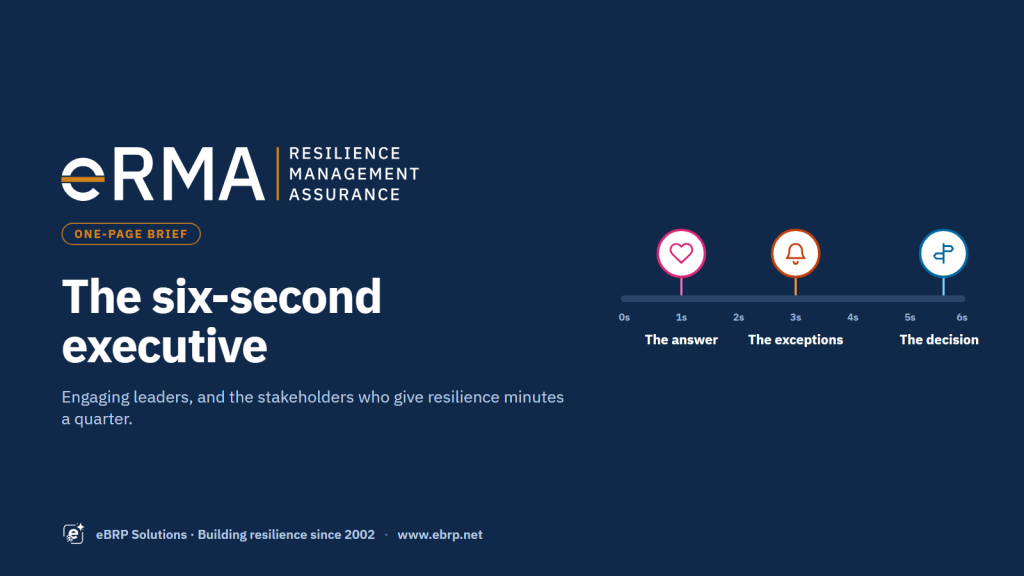
Ask any continuity manager how long a senior executive gives a resilience update, and the answer is short. Call it the six-second test: in the time it takes to glance at a page, a leader decides whether this needs them. Process owners have a similar test, measured in minutes a quarter. Most resilience programs are built for neither. They produce long reports for leaders and long questionnaires for managers, then wonder why neither engages.
Two audiences, one problem
Executives aren’t uninterested in resilience. They are uninterested in reading about it. Process owners aren’t against continuity planning. They are against answering the same questions every year with nothing to show for it. Both respond to the same thing: a clear reason to act, in the time they actually have.
For the six-second executive
1. Lead with one answer
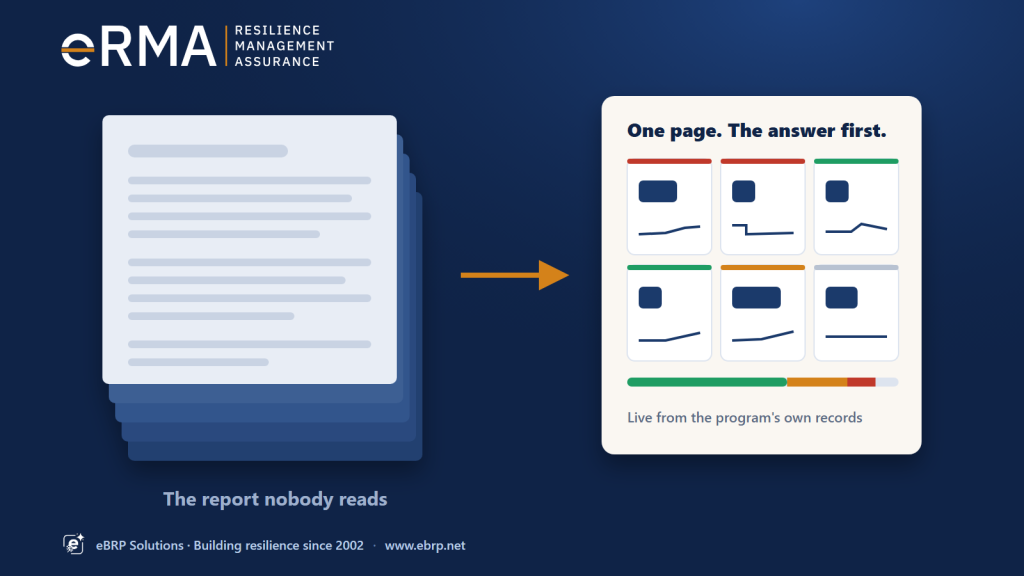
Open with the question a leader actually cares about: can the organization deliver its critical services within tolerance today? The answer is yes, no or unknown. Everything else is detail behind it.
2. Show the exceptions, not everything
Three items that need attention beat forty that don’t. A gap between a service’s tolerance and its dependencies, a plan never exercised, an overdue review: name them, and say what each one affects in business terms.
3. End with a decision
An update that asks for nothing gets nothing. Close every briefing with the decision needed: accept a risk, fund a fix, approve a plan, set a priority. Leaders engage with decisions, not with status.
One more rule: show “unknown” honestly. A dashboard that is green because data is missing will eventually be found out, and the program’s credibility goes with it. An honest gap is a reason to act.
For the disinterested stakeholder
4. Ask less, and ask once
Pre-fill what’s already known. Inherit answers shared across processes. Ask only for what has changed. A task that takes ten minutes gets done; one that takes two hours gets delegated, delayed or guessed.
5. Give something back
People engage with a system that shows them something useful about their own work: what their process depends on, who covers for whom, what happens to their team in a disruption. A program that only collects data will always be a chore.
6. Let them rehearse their own scenario
Interest usually changes when people walk through a disruption to their own process. An exercise built around a team’s real dependencies does more for engagement than any reminder email.
Where eRMA fits
eRMA, the resilience platform from eBRP Solutions, is built to be read quickly and maintained in minutes. All of the following are available today:
- Role-based workspaces that open on what needs each person’s attention, including leaders, rather than on a menu.
- Picture-first pages: graphical views such as the Impact Map lead with the picture of what depends on what, with the detail one click away.
- Honest status: “Unknown” is never shown as healthy, and “Restricted” is never shown as zero.
- Less to ask: group BIA with inheritance and live campaign progress, and the Employee Kiosk, where staff keep their own details current.
- Exercise: rehearse a scenario built from a team’s real dependencies, and record the results against each recovery objective.
See it: Business impact analysis →
Three questions to ask any vendor
- Show the first six seconds. What does a senior leader see on opening the platform, and is the answer obvious?
- Show a manager’s task. How many minutes does a process owner’s quarterly update take, and how much is already filled in?
- Show what’s in it for them. What does a process owner see about their own process that would bring them back?
Engagement isn’t a communications problem. It’s a design problem: the program has to fit the time people actually give it.
Download this as a one-page Brief: Engaging executives and stakeholders in resilience (PDF)
Join an eRMA showcase: sixty minutes, live on Microsoft Teams. · Download the eRMA brochure: see the possibilities.