Why Resilience, Risk and Compliance Belong on One Platform
Continuity, risk and compliance describe the same services, vendors and controls. What goes wrong when they live apart, and what integration should mean.
Ask eRMA
In many organizations, three teams describe the same things in three different tools. Business continuity maps services, applications, sites and vendors to recovery objectives. Risk management rates the same vendors and applications in a risk register. Compliance links the same services to regulations and tests the same controls for auditors. Each tool is internally consistent. Together they rarely agree, and the gaps between them are where problems hide.
What goes wrong when they live apart
- The same vendor is rated three ways. Critical in the BIA, moderate in the risk register, compliant in the audit file. Nobody notices until an incident or an examination does.
- The same control is tested three times. Once as part of an exercise, once as a risk treatment, once for a compliance audit, each by a different team with different evidence.
- Gaps fall between the tools. A high risk with no scenario or plan behind it. An obligation with no tested control. A recovery objective that has never been proven. Each team sees its own part, and nobody sees the gap.
- Evidence is assembled by hand. Every audit or regulatory request starts with exports and spreadsheets from several systems.
Why the three are converging now
Regulators increasingly look at operational risk and resilience as one subject. In Canada, OSFI Guideline E-21 brings operational risk management and operational resilience together. In the United States, the banking agencies’ sound practices paper on operational resilience builds on existing risk management, business continuity and third-party guidance. Gulf regulators such as SAMA and the CBUAE also expect continuity, cyber and operational risk to be governed consistently.
The standards point the same way. ISO 22301 and ISO/IEC 27001 share the same high-level structure, and ISO 31000 sets out the risk principles both rely on. Separate tools for each make that shared structure harder to show.
What “integrated” should mean
Integration is not a bundle of modules sold under one name. It means:
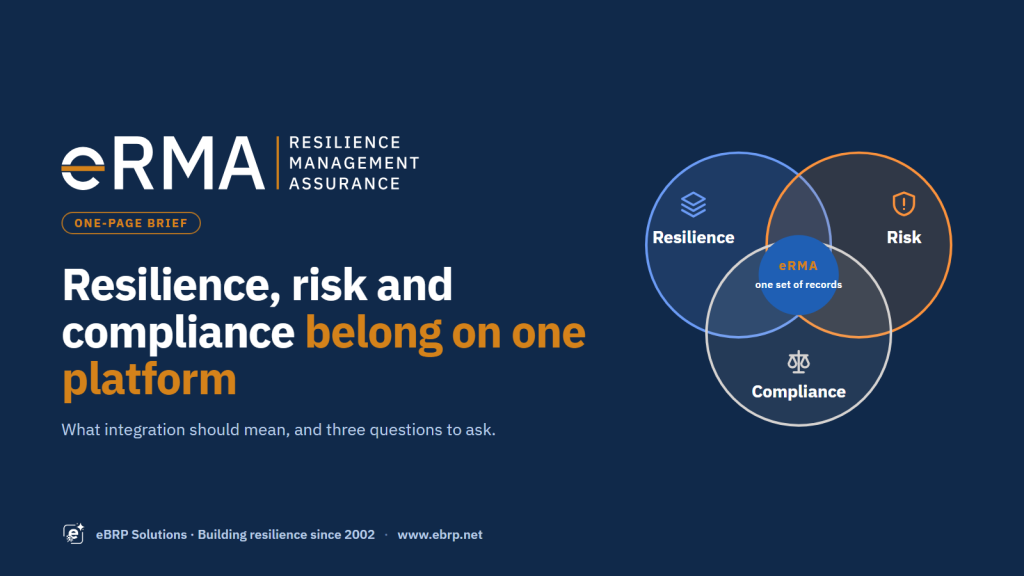
- One set of records. Services, processes, applications, sites and vendors exist once. The BIA, the risk register and the compliance view link to them rather than copying them.
- Test once, use many times. One control test, with its evidence, can support a risk treatment, several obligations and continuity assurance at the same time.
- Gaps visible across functions. A high risk without a scenario or plan, an obligation without a tested control, or an unproven RTO is shown as a gap, whichever team owns it.
- Shared data, separate accountability. Risk managers, compliance owners and continuity coordinators keep their own rights and decisions. Sensitive risks can stay restricted to the people who should see them.
- Traceable in both directions. From a regulation to the control and evidence that satisfy it, and from a service to everything it must meet.
Integration doesn’t mean buying everything at once
Many organizations start with continuity, add risk when the register outgrows its spreadsheet, and add compliance when audit demands grow. That works well, as long as each addition uses the same records rather than a new copy. The question to ask is not “does the vendor have a GRC module?” but “will the module I add next year use the data I enter this year?”
Where eRMA fits
eRMA, the resilience platform from eBRP Solutions, keeps continuity, risk and compliance on one set of records. Core eRMA includes the BIA, dependencies, plans, exercises, incidents and risk assessment on the same processes, applications, services, sites and vendors. Enterprise risk management and compliance extend it on the same data:
- Enterprise Risk Management (ERM): an ISO 31000 risk register in which each risk’s priority is computed, never typed in, and shows why it ranks where it does. It includes a control library with ISO 22301 and ISO 27001 references, a bow-tie of causes, controls and consequences, control tests with segregation of duties and attestation, and a flag on any high risk with no scenario or plan behind it.
- Compliance (GRC): regulations and obligations linked to the records already in eRMA, compliance posture per regulation, and a trace from rule to control to evidence. One tested control can satisfy many obligations, and owners attest that their obligations are met.
Risk and compliance rights are assigned through teams, and restricted risks stay visible only to the people who should see them.
Three questions to ask any vendor
- Show one vendor everywhere. Open a critical vendor in the BIA, the risk register and the compliance view. Is it one record or three?
- Show one test, many uses. Show a single control test supporting a risk treatment and more than one obligation.
- Show a gap between teams. Show a high risk with no plan behind it. Does the platform flag it, and who sees the flag?
Continuity, risk and compliance will keep their own teams and their own decisions. They no longer need their own copies of the organization.
Download this as a one-page Brief: Resilience, risk and compliance on one platform (PDF)
Join an eRMA showcase: sixty minutes, live on Microsoft Teams. · Download the eRMA brochure: see the possibilities.