 eRMA
Justifying a BCM Platform: A Business Case Finance Accepts
Business continuity cases often fail because they argue fear. Four value lines finance can test, built from your own numbers, plus a one-page worksheet.
Ask eRMA
Budget requests for business continuity often rest on one argument: a disaster would cost far more than the platform. That is usually true, and finance teams usually discount it, because it can’t be tested and it looks the same every year. A business case that gets approved does something different. It shows what the current way of working already costs, and which of those costs a platform removes, using numbers the organization can check.
Why “it prevents disasters” isn’t enough
Avoided-loss arguments ask finance to price an event that may never happen, at a probability nobody can defend. Reviewers treat them as soft benefits, which is fair. The stronger approach treats the avoided loss as the last line of the case, not the first, and builds the rest from costs the organization is already paying.
The current process is not free. Spreadsheets, survey tools, consultant refreshes and staff hours make up a budget nobody tracks. Making it visible is often the most persuasive part of the case.
Four value lines finance can test
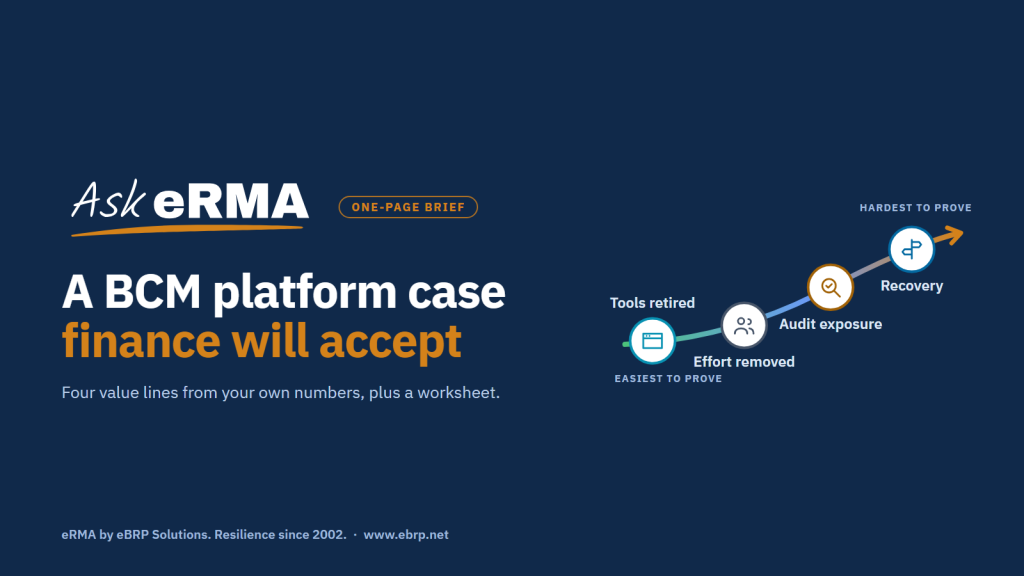
Order the benefits from easiest to prove to hardest. Finance reads from the top, and an early line it trusts makes the later ones more credible.
1. Tools and services retired
List what the platform replaces: survey tools, spreadsheet and SharePoint upkeep, a separate risk register, the consultant engagement behind the annual refresh, and any older continuity software still on contract. These are cash lines with invoices behind them, which makes them the easiest to verify.
2. Effort removed
Count the hours the program spends every year. How many managers complete the BIA, how long each questionnaire takes, and how many follow-ups it needs. Add the hours spent updating plans, preparing and writing up exercises, and collecting evidence for auditors. Multiply by a loaded hourly rate your finance team already uses.
Be precise about the claim: most of this is capacity freed, not cash saved. Say what the team will do with the time, such as more exercises or more coverage, rather than implying headcount reductions nobody has agreed.
3. Audit and regulatory exposure reduced
Don’t put a price on fines. Measure what auditors and regulators actually observe: open findings related to continuity, the time it takes to answer an evidence request, and how many recovery time objectives (RTOs) have been proven in an exercise rather than simply stated. Regulators in the United States, Canada and the Gulf increasingly expect evidence that operational resilience is tested, so a shorter answer time is a credible benefit on its own.
4. Recovery capability improved
This is the avoided-loss line, done properly. Use the impact figures from the organization’s own BIA. Where the platform closes a gap, for example a dependency whose recovery time is longer than its process can tolerate, estimate the hours of disruption it removes, and apply the impact per hour the business has already approved. Show a conservative and an expected value, never just the high one.
Be honest about the cost side
A case that only lists the subscription invites a second review. Include implementation, data migration, integration, training and the internal time needed during rollout. Then compare a three-year total cost of ownership against the three-year cost of the status quo, not against zero. Show a payback period, and say which month the first benefit appears.
Five rules finance respects
- Use the organization’s own numbers. Industry averages are easy to dismiss.
- Separate cash from capacity. Present them in different rows, and don’t add them together without saying so.
- Show a range. Conservative and expected values, with the assumptions written down.
- Give each benefit an owner. Someone who will report on it after twelve months.
- Measure the baseline now. Without today’s hours and findings, there’s nothing to compare against next year.
Where eRMA fits
eRMA, the resilience platform from eBRP Solutions, maps to each value line. All of the following are available today:
- Tools retired: BIA, dependencies, plans, exercises, incidents and risk assessment on one data set, with ERM and Compliance (GRC) available as optional add-on modules.
- Effort removed: group BIA with inheritance, so shared answers are given once; live campaign progress instead of chasing by email; the Employee Kiosk, where staff keep their own details current; and Data Management templates with pre-checks and dry runs for bulk loads.
- Audit exposure: Exercise results recorded per entity against its RTO, with the evidence kept, plus role-based views that show “Unknown” rather than a false green.
- Recovery capability: the Impact Map shows where recovery times don’t line up, and the Plan Sequencer shows the full recovery path to check against tolerance.
See it: Business impact analysis →
Three questions finance will ask
- What does the current way of working cost today? Have the hours, tools and consultant fees ready.
- Which savings are cash and which are capacity? Answer before you’re asked.
- How will we know in twelve months? Name the measures and their owners.
The one-page Brief includes a worksheet with each value line and space for your own figures.
Download the worksheet as a one-page Brief: Business case worksheet for a BCM platform (PDF)